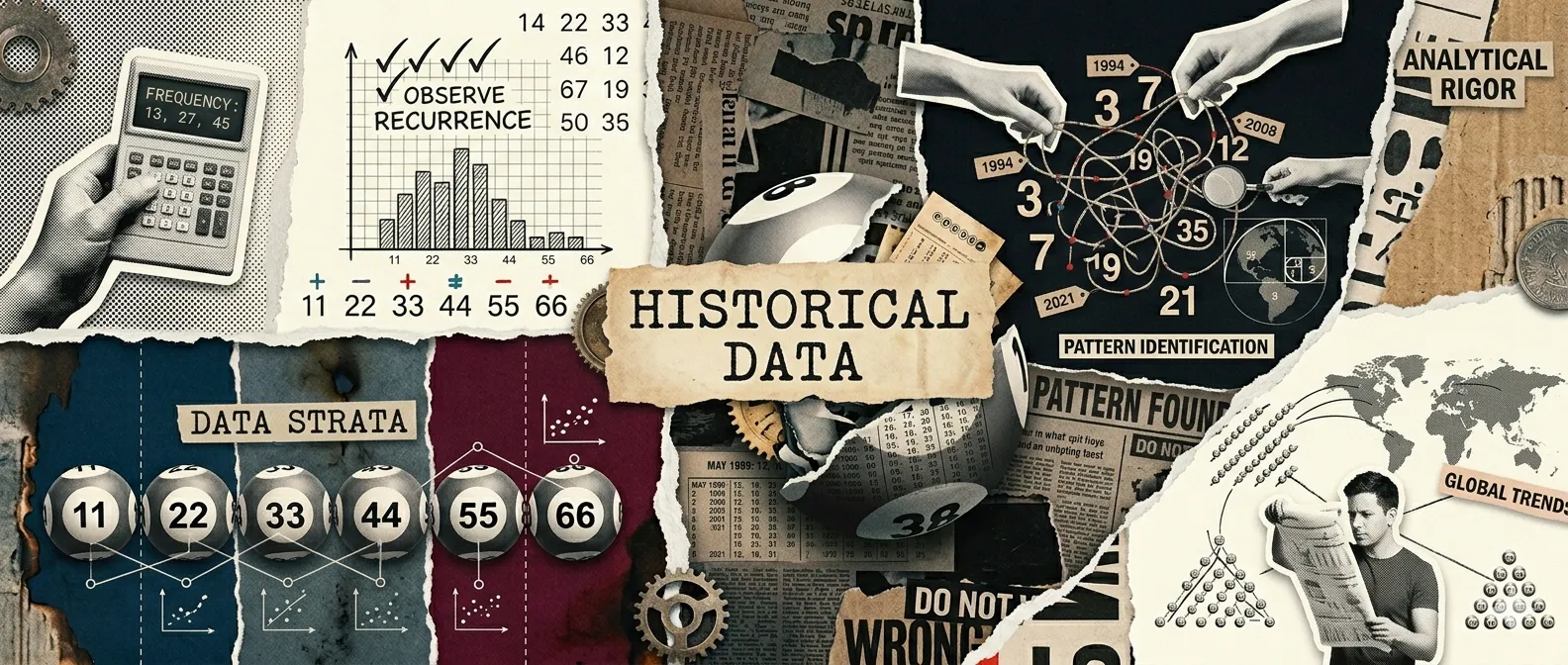
Every lottery drawing generates data—thousands of data points that reveal the mathematical nature of randomness. While lottery draws are fundamentally random events where past results don't predict future outcomes, analyzing historical drawing data provides fascinating insights into distribution patterns, frequency trends, and the behavior of lottery systems themselves. Understanding what this data actually reveals (and what it falsely promises) empowers smarter lottery participation.
The Paradox: Random Events and Pattern Analysis
Here's the central tension that confuses many lottery players: lottery drawings are designed to be random, yet genuine randomness produces patterns. This seems contradictory, but it's mathematically inevitable. Flip a coin 1,000 times, and you won't get perfectly alternating heads and tails—you'll see streaks, clusters, and patterns that feel non-random even though the process is fundamentally random.
Lottery systems work the same way. Analyzing historical data is valuable for understanding system behavior and distribution patterns, but it's critical to distinguish between what data reveals about randomness versus what it cannot predict about future draws.
What Historical Lottery Data Actually Shows
Distribution and Frequency Analysis
When analyzing decades of Powerball drawings (tens of thousands of individual number occurrences), clear patterns emerge:
- Overall distribution: Every number from 1-69 appears with approximately equal frequency over long-term analysis. The Law of Large Numbers ensures that as draws accumulate, each number approaches its theoretical expected frequency (appearing roughly 1/69th of the time)
- No number is "overdue": A number that hasn't appeared in 500 drawings has identical probability of appearing in the next draw (1 in 69) compared to a number that appeared last week
- Apparent "clusters" are normal: Seeing the same number appear three times in a week, or a sequence like 5-6-7 in a single drawing, is statistically expected in random data
- Hot and cold numbers are illusions: Numbers that appeared frequently in the past two months are no more likely to appear in the next two months than any other number
The Gambler's Fallacy and Why It Persists
The Gambler's Fallacy is the belief that past results influence future probability in independent random events. If a coin landed on heads 10 times in a row, the next flip has 50% probability of tails—not 90% just because tails is "due." Yet this fallacy drives significant lottery strategy:
- Approximately 35-40% of lottery players base number selection on "cold numbers" (numbers not drawn recently)
- Another 25-30% chase "hot numbers" (frequently drawn recently)
- Both groups statistically underperform in payout potential because these beliefs drive selection toward popular numbers
The mathematical reality: if a number appeared 3 times last month and another appeared zero times, both have precisely 1 in 69 probability in the next draw. The past frequency is literally irrelevant.
Understanding the Data: What Actually Matters
Long-Term Distribution Verification
Analyzing historical data serves one legitimate purpose: verifying that the lottery system is functioning as designed. Over thousands of drawings, numbers should appear with roughly equal frequency. Significant deviation would suggest mechanical or software issues with the lottery machine.
Fortunately, independent audits consistently verify that major U.S. lotteries are random systems producing appropriately distributed outcomes. The occasional number that appears slightly more or less frequently than average is precisely what statistics predicts will happen.
Combination Frequency: Repeat Wins and Unlikely Occurrences
A more interesting historical analysis examines whether certain number combinations repeat or appear more frequently:
- Truly repeated exact matches (all five numbers plus Powerball recurring) have never occurred in Powerball history despite 30+ years of drawings
- Combinations with 4 matching numbers do repeat occasionally, roughly aligned with probability expectations
- The statistical probability of observing any particular pattern in thousands of draws can be calculated, and observed patterns consistently match mathematical predictions
These observations confirm system randomness rather than reveal exploitable patterns.
Time-Based Variations
Some lottery analysis examines whether certain times (day of week, time of year, seasonal variations) produce different results:
- Monday versus Wednesday versus Saturday drawings show no significant distribution differences
- Holiday periods show no anomalies in number selection or frequency
- Seasonal variations in player behavior don't correlate with different drawing outcomes
While player behavior varies seasonally (more tickets during large jackpots), the actual random draws remain unaffected.
The Correlation Trap: Missing the Real Story
A critical mistake in lottery analysis is confusing correlation with causation and seeing patterns in noise. Consider these examples:
Example 1: "Number 7 appeared in 8 of the last 10 drawings—it's hot, I should play it." Reality: This is a minor clustering that statistically occurs about once per decade in large lottery datasets. Past frequency doesn't predict future draws.
Example 2: "Numbers 1-10 haven't produced a jackpot winner in 2 years—they're due." Reality: The absence of any winning ticket using only numbers 1-10 is perfectly normal given that millions of potential combinations exist. Absence of evidence is not evidence of anything.
Example 3: "This lottery number combination is unique—it's never appeared before." Reality: In a system with tens of millions of possible combinations and only a few thousand draws, nearly every single combination has never appeared. That the combination is "new" is statistically inevitable.
What You Can Learn From Historical Data
1. System Integrity Confirmation
Historical analysis demonstrates that your lottery operates as designed. Numbers appear with appropriate frequency, no systematic bias exists, and the draws are genuinely random. This is valuable information for confidence in the system's fairness.
2. Probability Distribution Visualization
Seeing the data visually—how 1,000 or 10,000 individual number appearances distribute across 69 possible values—reinforces understanding of randomness. The histogram shows some variation around the expected mean, which is precisely what statistics predicts. This can combat the "hot and cold" fallacy.
3. Combination Rarity Assessment
You can calculate how many previous drawings have occurred (establishing your lottery's draw history) and understand that unique or rare-seeming combinations are statistically normal in large possibility spaces.
4. Edge Case Understanding
Historical data reveals the reality of rare events—like how often jackpots are split, how frequently smaller prize tiers are won, and statistical probabilities of various outcomes. This reality-checks expectations.
The Data You Should Ignore
- Recent frequency: Which numbers appeared most/least in the past 10, 50, or 100 drawings
- "Due" calculations: Which numbers "should" appear based on absence
- Clustering patterns: Unusual sequences that feel meaningful but are mathematically expected
- Lucky number data: Historical prevalence of particular numbers that hold superstitious significance
- Temporal patterns: Weekend versus weekday variations, monthly patterns, seasonal effects
None of this information has predictive power for future draws, and acting on it typically leads to worse outcomes.
Advanced Analysis: What Professional Data Scientists Find
When serious statisticians and data scientists analyze massive lottery datasets, they consistently reach the same conclusions:
Finding 1: The lottery systems work. No exploitable patterns exist. The random number generators used in modern lotteries are genuinely random within acceptable statistical tolerances.
Finding 2: Player selection patterns are highly non-random. The numbers people choose cluster dramatically around birthdays, lucky numbers, sequential patterns, and multiples. This is the actual pattern in lottery data—not in the draws themselves, but in how millions of players choose numbers.
Finding 3: This player-selection clustering is exploitable only in one direction: by avoiding popular patterns, a winner increases payout-sharing value. The sophisticated application of lottery data isn't predicting draws—it's understanding player behavior to optimize payout potential.
Using Data Intelligently
Distribution-Based Selection
If you want to use historical data strategically, the only evidence-based application is this: ensure your number selections don't cluster in the ranges that most players choose (typically 1-31). Using historical frequency data to verify that all numbers appear with similar frequency confirms that you can safely use any numbers—the strategic insight is that numbers most players avoid (32-69) have higher expected payout value if won.
Combination Analysis
Historical data can inform you which specific combinations have never been drawn (almost all of them) but that's uninformative for prediction. What matters is that sequences, multiples, and patterns appear less frequently in your ticket than higher numbers—and that's behavioral data about player choices, not about future draws.
Avoiding Data-Driven Fallacies
The most important application of historical lottery data is inoculating yourself against common misinterpretations. Understanding the data deeply actually undermines most popular lottery strategies that claim to be "data-based."
Tools for Data-Driven Lottery Understanding
For players genuinely interested in understanding lottery data, distributions, and analysis—moving beyond superstition toward mathematical literacy—specialized tools can visualize historical data, calculate probabilities, and provide analytical frameworks.
Explore Lottery Data with Lotto Matrix
Disclaimer: This article is for educational purposes only. Historical lottery data, while mathematically interesting, cannot predict future draws. Past results do not influence future outcomes in random drawings. Never base significant financial decisions on pattern analysis from lottery data. If you're struggling with gambling or compulsive play, seek help from organizations like the National Council on Problem Gambling.